The Women's Victory and After: 1911-1918 by Millicent Garrett Fawcett
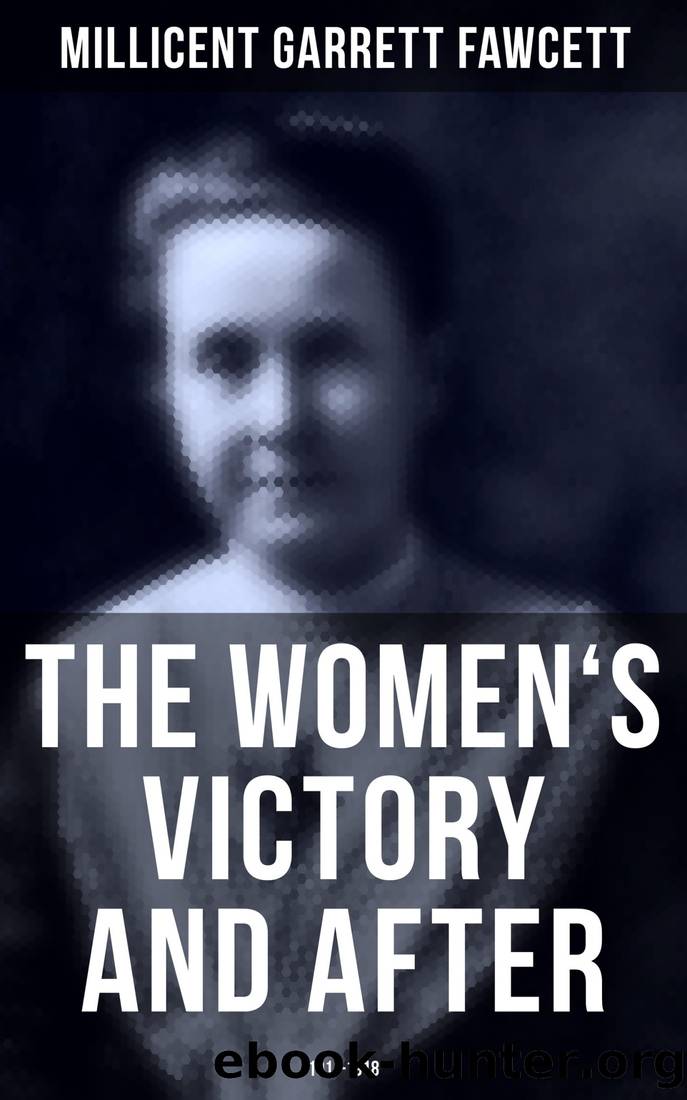
Author:Millicent Garrett Fawcett [Fawcett, Millicent Garrett]
Language: eng
Format: epub
Tags: Reference, General, Feminism & Feminist Theory, Nonfiction, Fiction, Classics, Biography & Memoir, Social Science, Gender Studies, Social & Cultural Studies
ISBN: 9788027242771
Google: Ia7EDwAAQBAJ
Barnesnoble:
Publisher: Musaicum Books
Published: 2018-03-21T04:00:00+00:00
I have already touched in an earlier chapter on the most important of all the war activities of the N.U.W.S.S.âthe Scottish Women's Hospitals for Foreign Service, initiated and carried through by the genius and devotion of the hon. secretary of our Scottish Federation, Dr. Elsie Inglis. Her name and her great work are now known and honoured throughout the world, and it is unnecessary here to dwell upon them at any length. In the old days before the war Dr. Inglis used to say she had two passions, "suffrage and surgery." Before the end of her honoured life came she added to these two S's yet another, "Serbia." How this came about is worth recalling, and can be studied in detail in the "Life of Dr. Elsie Inglis," by Lady Frances Balfour. It affords an example of "the soul of goodness in things evil would men observingly distil it out." Her first wish in September, 1914, was to place her services, her knowledge and skill in her profession, at the service of her country. In an interview with a high official of the R.A.M.C. at the War Office in that month, when she asked his advice as to what course she should take, his reply was: "Dear lady, go home and keep quiet"âin other words, her help was refused. The British Red Cross adopted the same attitude. She was therefore compelled to place her organization under the French Red Cross. The great hospital at Royaumont was the first to be established. The N.U.W.S.S. Scottish Women's Hospitals were complete hospital units, officered entirely by women. The physicians and surgeons, nurses, dressers, orderlies, motor drivers, and domestic staff were all women. The whole scheme was initiated by Dr. Elsie Inglis, and was enthusiastically taken up by the whole N.U.W.S.S. The work quickly grew to large proportions. I have a letter from Dr. Inglis, dated October 13th, 1914, on the financial aspect of her scheme. At that date she only had £213 in hand. At the date of writing this, August 18th, 1919, the total collected for the S.W.H. amounted to £428,905 1s. 3d. The total number of beds in France and Serbia for which the organization was responsible exceeded 1,800. Powerful committees were formed in Scotland, South Wales, and in London to support the hospitals, and their membership was not confined to the N.U.W.S.S.âindeed, especially in Scotland, several influential non-suffragists joined in promoting the great work. It must not for a moment be supposed that only suffragists were active and devoted. It was recognized by the instinctive common sense of the great majority of women throughout the whole country, suffragist and non-suffragist, militant and non-militant, that their first duty was by every practical means in their power to strengthen the resources of their country so as to aid it to issue successfully from the great struggle. Those who took a contrary view did exist, but their numbers were very small. But it is a source of pride and thankfulness that the womanhood
Download
This site does not store any files on its server. We only index and link to content provided by other sites. Please contact the content providers to delete copyright contents if any and email us, we'll remove relevant links or contents immediately.
Waking Up in Heaven: A True Story of Brokenness, Heaven, and Life Again by McVea Crystal & Tresniowski Alex(37772)
Still Foolin’ ’Em by Billy Crystal(36339)
Cecilia; Or, Memoirs of an Heiress — Volume 1 by Fanny Burney(32533)
Cecilia; Or, Memoirs of an Heiress — Volume 2 by Fanny Burney(31931)
Cecilia; Or, Memoirs of an Heiress — Volume 3 by Fanny Burney(31920)
Fanny Burney by Claire Harman(26587)
Empire of the Sikhs by Patwant Singh(23063)
We're Going to Need More Wine by Gabrielle Union(19023)
Hans Sturm: A Soldier's Odyssey on the Eastern Front by Gordon Williamson(18559)
Plagued by Fire by Paul Hendrickson(17394)
Out of India by Michael Foss(16837)
All the Missing Girls by Megan Miranda(15901)
Cat's cradle by Kurt Vonnegut(15312)
Pimp by Iceberg Slim(14470)
Molly's Game by Molly Bloom(14125)
Bombshells: Glamour Girls of a Lifetime by Sullivan Steve(14041)
For the Love of Europe by Rick Steves(13836)
Leonardo da Vinci by Walter Isaacson(13296)
4 3 2 1: A Novel by Paul Auster(12358)
